Search This Blog

Loading...

Sunday, 19 May 2013

Paranormal Shakespeare

Today, Shakespeare’s plays are the epitome of respectable mainstream culture, while all things paranormal are relegated to the crackpot fringe. Aspiring authors who want their books to be studied in the hallowed halls of English Literature would be well advised to steer clear of tales of ghosts, witches, demons and sorcery. Such topics are a sure sign of lowbrow fiction, aren’t they? But the plays of Shakespeare are anything but lowbrow, and they’re packed full of tales of ghosts, witches, demons and sorcery.

Shakespeare was the archetypal Renaissance Man. He was a contemporary of Galileo and Francis Bacon, the pioneers of the scientific method, and also of John Dee – the most famous occultist in English history. As Shakespeare’s most famous character, Hamlet, said: “There are more things in Heaven and Earth, Horatio, than are dreamt of in your philosophy”. Horatio’s philosophy was Humanism – the precursor of modern Skepticism. Shakespeare himself was more open-minded.

A previous post (More things in Heaven and Earth) described the pivotal role played by the paranormal in Hamlet. This is one of the most highly-regarded works of English literature, and yet the whole action of the play is set in motion by an encounter with a ghost. The apparition is seen by multiple witnesses, and it imparts information that later turns out to be true – although it couldn’t have been obtained by non-paranormal means (for more on the ghost in Hamlet, see The Ghost of Lulworth Cove on the Dark Dorset blog).

Hamlet isn’t the only work by Shakespeare where paranormal phenomena play a central role. In Macbeth, the title character is set on his road to power (and his ultimate downfall) by the prophecies of the three witches. Everything the witches predict during the course of the play comes to pass... although not always in the way Macbeth expects. The witches in Macbeth aren’t the evil Satan-worshippers of mediaeval imagination, but wise and superhumanly powerful women in the pagan tradition.

And that’s just the start of it. There are ghostly encounters in Julius Caesar and Richard the Third. There’s magic and sorcery in The Tempest, and midnight necromancy in Henry VI Part 2. There’s astrology and demonology in King Lear. There are paranormal-inspired high jinks in The Merry Wives of Windsor and The Comedy of Errors. And much more.

You can read all about Paranormal Shakespeare in a short ebook by myself that’s just been published by Bretwalda Books. It’s available from various places, including Amazon.com, Amazon UK, iTunes, Barnes & Noble and W H Smith.

Sunday, 12 May 2013

200 Years of Forteana

This is the 200th post on the Forteana blog. That doesn’t mean it’s been running for 200 years (or even 200 weeks), but I still thought it would be fun to list a few highlights from the last two centuries of Forteana:

1813: Birth of Richard Wagner. Many years later (1980 to be precise), Roy Thomas used Wagner’s Der Ring Des Nibelungen as the story arc for issues 294 to 300 of The Mighty Thor – as recounted in A Wagnerian Thor.

1816: The Year Without a Summer, when Byron wrote his apocalyptic poem Darkness and Mary Shelley started work on Frankenstein.

1817: Birth of Hargrave Jennings, who went on to become an enthusiastic proponent of Phallicism – A Victorian Theology of Everything (see also Phascinating Phacts).

1819: The British Museum purchases its first ichthyosaur fossil, from a 20-year-old girl named Mary Anning – who, if legend is to be believed, was a rather dim-witted child until she was struck by lightning (see On the Diverse Benefits of being Struck by Lightning).

1821: Premiere of Weber’s opera Der Freischütz – a “pact with the devil” story and a classic example of Fortean Opera.

1827: Death of William Blake – artist, poet, mystic... and A 19th Century Contactee?

1829: The satirical artist William Heath produces a print entitled March of the Intellect, depicting what appears to be An Intercontinental Rapid Transit System.

1832: Birth of Charles Dodgson, who wrote under the pen-name of Lewis Carroll. His works for children (such as Alice in Wonderland) are still remembered today, while his books on mathematics are almost forgotten – see Sea Serpents, Logic and Lewis Carroll.

1844: The term Lisztomania is coined by the poet Heinrich Heine, to describe the hysterical behaviour of certain females in response to performances by Franz Liszt.

1847: The British archaeologist Austen Henry Layard explores the ruins of the ancient Assyrian city of Nineveh, discovering among other things a huge wall carving depicting The Siege of Lachish – now on display in the British Museum (and the subject of an ebook by myself).

1848: The poet Tennyson, on a visit to Cornwall, sees King Arthur's Stone – which later inspires him to write Idylls of the King.

1856: Death of William Buckland: an early Fortean experimenter, who subjected a common piece of folklore—the idea of “toads trapped inside solid rock” —to practical test.

1861: Death of Prince Albert, the consort of Queen Victoria, who was subsequently commemorated in the Albert Memorial... and The Frieze of Parnassus.

1871: The Scottish physicist James Clerk Maxwell proposes a “thought experiment” involving one of the few demonic entities acceptable to modern science: Maxwell’s Demon.

1872: The German astrophysicist Karl Zöllner is the first person to suggest that the universe we live in may be non-Euclidean – a major step towards Inventing the Fourth Dimension.

1874: Birth of Charles Fort, who besides giving his name to this blog is the subject of a minor subdivision of imaginative literature – Charles Fort in Fiction.

1885: H. Rider Haggard produces his most famous novel, King Solomon's Mines – which includes an interesting take on the subject of Travellers from the Stars.

1887: Abbé Saunière embarks on a number of extravagant renovations to the church at Rennes-le-Chateau... including The Devil of Rennes-le-Chateau.

1895: Publication of The End of Books – a short story written by Octave Uzanne and illustrated by Albert Robida, containing a surprisingly prescient vision of iPods and audiobooks.
1896: Aubrey Beardsley produces an appropriately surreal illustration of “The Cave of Spleen” from Alexander Pope’s The Rape of the Lock... complete with Angels in Machines.

1906: Birth of John Dickson Carr, one of the best (and most Fortean) mystery novelists of the 20th century – as described in A Trip to the Witches' Sabbath and Simulacra in fiction.

1909: Publication of The Machine Stops by E. M. Forster. With a century of hindsight, this can be read as a satire on social networking... and, with its firm insistence on “No Original Research”, a Wikipedia Prophecy.

1914: Socrates Scholfield of Providence, Rhode Island is granted U.S. patent 1,087,186 for a device to demonstrate the relationship between the Supreme Being and His Creation – The Double Helix of God.

1918: Publication of The Gate of Remembrance by Frederick Bligh Bond, revealing how his recent excavations at Glastonbury Abbey had been an exercise in Psychic archaeology.

1924: A British Air Ministry memorandum states that Germany is in possession of “an apparatus from which rays (or electric waves) can be projected to a height causing aeroplane engines to break down” – just one of many instances of Death Rays of the 1920s and 30s.

1926: Father Ronald A. Knox broadcasts an outrageously over-the-top comedy programme about rioting in London, which the press promptly hypes up into The First Radio Hoax.

1935: The May issue of Doc Savage magazine contains a painstakingly detailed description of a telephone answering machine, before such things even existed – an example of Futuristic gadgets of the 1930s.

1939: The first issue of a new pulp magazine, called Unknown, hits the stands in March. Complete in this issue is Eric Frank Russell’s Sinister Barrier: the first Fortean novel.

1942: An inscription bearing this date, in the cuneiform script of ancient Assyria, can be found in an underground mine-working in Wiltshire – The Bomb-Proof Museum.

1943: Accurately reported in an anonymous phone call on 25 May, but not actually occurring until 4 July – The Strange Death of General Sikorski.

1944: On 8 September, the first of more than a thousand V-2 rockets is launched against the city of London – as recounted in London versus the V-2 rockets (and also the subject of an ebook by myself).

1945: In December, five US Navy torpedo bombers go missing in the Bermuda Triangle, soon followed by a search aircraft looking for them. By August of the following year, paranormal explanations of The Mystery of Flight 19 are already being put forward.

1948: Time for another mystery – less well-known than the Bermuda Triangle, but arguably more intriguing – The Tamam Shud Mystery.

1950: Publication of Gerald Heard’s The Riddle of the Flying Saucers, the first non-fiction English-language book to deal with the subject... and one most people have never heard of. Read all about it in UFOs: the forgotten book.

1958: The second issue of Harvey Comics’ Race for the Moon contains a story by Jack Kirby entitled The Face on Mars ... thirty years before Mark Carlotto drew the world’s attention to that particular feature of the Martian landscape.
1960: As Che Guevara made a brief appearance at a rally in Havana, Alberto Korda took a quick photograph, which he later dubbed Guerrillero HeroicoThe portrait with a life of its own.

1961: Three weeks after Soviet Cosmonaut Yuri Gagarin orbits the Earth in Vostok 1, American astronaut Alan Shepard is lobbed three hundred miles downrange from Florida on the end of a 1953-vintage short-range ballistic missile, in history’s most blatant example of a Hyperbolic Orbit (“hyperbolic” in the sense of “greatly exaggerated”).

1962: The British UFO Research Association (BUFORA) holds its first meeting in September – as remembered with nostalgia in September 2012, marking Fifty Years of British UFO Research.

1965: The British science fiction author John Brunner writes a glowing piece in New Worlds magazine, drawing attention to a then little-known author by the name of Philip K. Dick – as recorded in Philip K. Dick - two early British viewpoints (see also John Brunner: a British Philip K. Dick?).

1968: The September/October issue of Flying Saucer Review contains, among other things, a circuit diagram for an electronic UFO detector that anyone who wants to can build for themselves.

1973: Uri Geller gives such a persuasive performance on the Dimbleby Talk-In that Professor John Taylor, brought in as a skeptical scientist, becomes a paranormal believer right there in front of the TV cameras. I chose this as the first of my five Fortean Events that Shook the World.

1981: Stephen Hawking and other prominent scientists convene at Castel Gandolfo, the Pope's Summer Residence, for a study week on Cosmology and Fundamental Physics organized by the Vatican's Pontifical Academy of Sciences – as described in Vatican Cosmology.

1992: Nick Pope, newly arrived at the UFO Desk in MOD Main Building, is interviewed by the MOD’s house journal (this was before anyone in the UFO community had heard his name). I kept the clipping for a few years, then threw it away – which is a pity, because it would probably be worth millions today (or maybe not). See Nick Pope at the MOD for this and more Popean anecdotes.

1997: At a meeting with a group of physicists and cosmologists, the Dalai Lama declares himself to be open-minded on the subject of alien encounters – as recounted in The Dalai Lama, quantum physics and UFOs.

2001: The European Space Agency sets up the ITSF (Innovative Technologies from Science Fiction) database – Novel space technologies from such great thinkers as Arthur C. Clarke, Larry Niven, Robert A. Heinlein and Isaac Asimov.

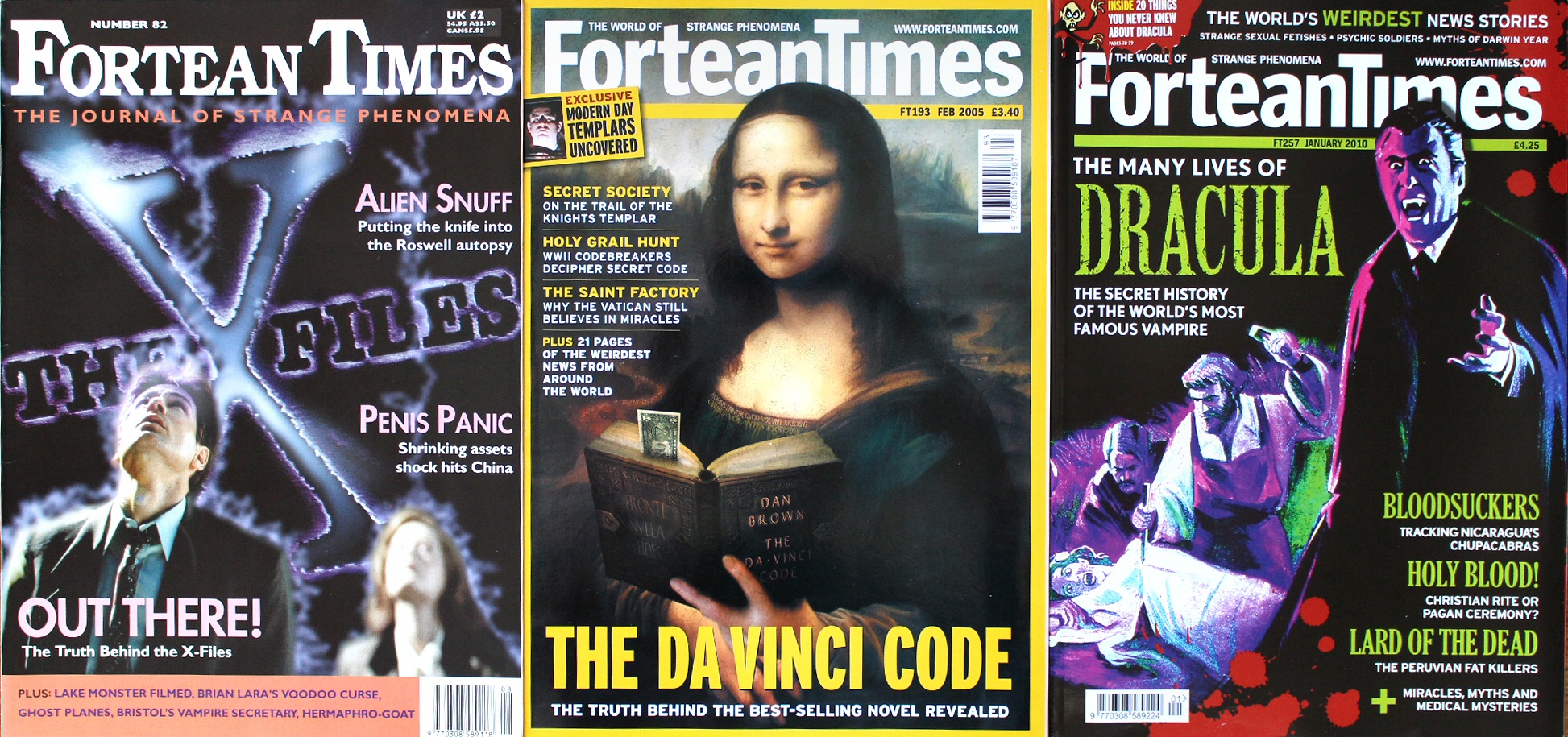
2005: The original (and much missed) Hierophant made his last appearance in the January issue of Fortean Times. For the low-down on the over-educated, bad-tempered, humourless impostor who tried to take his place, see The Hierophant Mystery.

2006: The bizarre Da Vinci Code trial, presided over by a judge who clearly knew more about the subject matter of Dan Brown’s novel than the author himself did (and who embedded a code of his own in his final judgment) was the fifth and last of my Fortean Events that Shook the World.

2011: At the Institute of Biomedical Problems in Moscow, the six-man crew of the MARS-500 mission enters orbit around the red planet after eight months in space... an echo in the real-world of the recurring sci-fi theme of Phony space missions.

2013: February sees two major announcements about DNA results – one of which is widely applauded while the other... isn’t. It’s all explained in Bigfoot, Richard III and Outsider Science.

Sunday, 5 May 2013

The Frieze of Parnassus

The Albert Memorial in Kensington Gardens isn’t London’s most popular tourist attraction. When it was erected in 1872 it was the height of fashionable good taste, but within a few decades it had become a symbol of bad taste... and has remained so ever since. Personally I love high Victorian Gothic architecture, but I know I’m in a minority so I won’t go on about it.

The central focus of the Albert Memorial is, of course, the huge seated figure of Prince Albert (the consort of Queen Victoria). But there are many other sculptures that deserve (but rarely get) close scrutiny. In particular there’s the Frieze of Parnassus that surrounds the base of the memorial. This depicts 160-plus historical figures from the world of the Arts. Although it’s not obvious from my photograph, each of the figures is identified by name – the Wikipedia article has clearer photographs and a full list of names.

When faced with lists like this, it’s inevitable that questions of the “why didn’t they include X?” variety spring to mind. Of course, the figures are necessarily drawn from the limited range of cultures familiar to mid-19th century Londoners – the ancient world of Egypt, Greece and Rome, and the post-renaissance world of Western Europe. In addition, the figures are limited to five specific categories – Poets, Musicians, Painters, Sculptors and Architects. But even within these constraints there are some notable omissions. I thought it would be interesting to go through all the people I’ve mentioned in previous posts who meet the basic criteria, and see which of them are included and which aren’t.

POETS

There aren’t as many poets depicted as you might expect. This is because they share the south side of the frieze (that’s the one in my photograph) with musicians.

Shakespeare is one of only three English poets to make it onto the frieze. He featured previously in connection with the authorship question and the ghost in Hamlet. If you’re interested in the latter, then watch this space – there’s more paranormal Shakespeare in the pipeline.

Alexander Pope (who featured in Angels in Machines last year) is a good example of someone who ought to be on the frieze but isn’t. The only post-Shakespeare English poet who does make the cut is John Milton, who was mentioned in passing in The Great Pyramid, and other British inventions – due to his rather nutty suggestion that the Greek philosopher Pythagoras got all his ideas from the ancient Britons. Oddly, Pythagoras appears on the frieze as a “poet” too, four places to the left of Milton.

Two of Britain’s greatest poets, Samuel Taylor Coleridge (featured in The Person from Porlock and The Ancient Mariner) and Lord Byron (featured in The Year Without a Summer) don’t make it onto the frieze, whereas Goethe and Schiller – two German poets of the same period – do.

Of the other non-English poets depicted on the frieze, Homer was featured in Space Odyssey and Dante in Dante’s Divine Comic Book.

MUSICIANS

Haydn, Mozart and Weber are the only three composers featured in Fortean Opera who died before the Frieze of Parnassus was created – and they are all on it.

Four of the composers mentioned in Philip K. Dick, music critic meet the same criterion – but only three of them are on the frieze. Bach, Mozart (again) and Beethoven made it, but Schubert didn’t.

PAINTERS

Botticelli, who featured in The Mystic Nativity, is conspicuously absent from the Frieze of Parnassus. This is odd because, as I said in that post, Botticelli “had a major influence on British painting of the Victorian period”. It’s even stranger that Botticelli’s more obscure contemporary Ghirlandaio is on the frieze.

Looking at the various omissions – Pope, Byron, Coleridge, Schubert, Botticelli – it strikes me they are all purveyors of what might be called “accessible” art. Maybe they weren’t considered sufficiently heavyweight to be commemorated in stone!

That’s certainly not true of the other great figures of the Florentine Renaissance—Leonardo da Vinci, Raphael and Michelangelo—who are all there on the frieze. In fact Michelangelo makes two appearances, both as a painter and as a sculptor! Both Michelangelo and Leonardo were featured in The Da Vinci Code and medieval symbolism, with Michelangelo also cropping up in A sixteenth century dinosaur and Leonardo in Underground Art and Crashed UFO in London. Raphael featured in my post about The School of Athens (which also mentions Pythagoras, referred to earlier).

Bellini was the subject of Descent into Limbo, and Mantegna was also mentioned in that post. Both Bellini and Mantegna are shown on the frieze.

The only other Italian artist I remember featuring is Agostino Carracci, in Bacchus and Ariadne. If you look back at that distinctly R-rated post, you won’t be surprised to learn the Victorians didn’t include Agostino in their frieze. However, Agostino’s brother Annibale Carracci (mentioned in the same post) did make the cut.

Vermeer (who featured in Chasing Vermeer... and Charles Fort) isn’t on the frieze – possibly because he falls in the “too accessible” category. But I was pleased to see that Hogarth – the epitome of accessible art – is right up there on the Frieze of Parnassus. Hogarth featured in Paranormal investigation, 18th century style and Another historical myth-conception.

Turner (who featured in Enigmatic Art) is on the frieze, but needless to say his populist contemporary John Martin (featured in Art and Archaeology) isn’t. Incidentally, one of Martin’s most characteristic works is “Joshua commanding the Sun to stand still upon Gibeon” (1816). I recently came across another version of the same scene that Martin painted in 1848 in a more Turneresque style. They’re both reproduced here (1816 top and 1848 bottom) so you can decide which you like best (I think they’re both great pictures).

SCULPTORS

I can only remember mentioning a sculptor once – that was Donatello in Alien simulacrum, one of my very first blog posts. Anyway, Donatello is there on the Frieze of Parnassus.

ARCHITECTS

As far as the Frieze of Parnassus is concerned, the “architects” of the ancient world aren’t really architects but patrons of architecture – the people who commissioned the buildings, rather than the people who designed them (the identities of the latter being lost in the mists of time). So, for example, “Cheops” is depicted as the architect of the Great Pyramid. Interest in Egyptology was still relatively new when the Albert Memorial was built, and the great wave of pyramidiocy that swept over the English-speaking world came later (see The Great Pyramid, and other British inventions, already mentioned above).

One of the oddest inclusions is Sennacherib, who would have been best known in Victorian times as the villain of a popular poem by Lord Byron (who unlike Sennacherib didn’t make it onto the Frieze of Parnassus). Presumably Sennacherib was considered the “architect” of the city of Nineveh, which had only recently been unearthed by archaeologists when the Albert Memorial was built. Sennacherib was mentioned in my posts on The Bible's Excluded Middle, Gods of the Bible and The Siege of Lachish... the last being about my ebook of the same title (which will tell you all you need to know about Sennacherib, should you choose to buy it).

Sunday, 28 April 2013

The Strange Death of General Sikorski

General Władysław Sikorski (pictured above and in the two pictures below) is one of the less well-remembered leaders of the Second World War. He was effectively the Polish equivalent of General de Gaulle – the military and political leader of his country, in exile in the UK, after it had fallen to the Germans. Both men were seen as charismatic and inspiring by their own people, and as forceful and intransigent by the other Allied leaders.

The war in Europe was won by a coalition of three powerful nations: the United States, the Soviet Union and the United Kingdom (together with other members of the British Commonwealth such as Canada and Australia). Yet after the War, Germany was divided not into three zones but into four. The fourth zone was French. Why on earth was that? Because the forceful and intransigent General de Gaulle suggested it.

General Sikorski never lived to make a similar suggestion vis-à-vis Poland. There's an article by me on the subject of his death in the latest issue of Fortean Times (FT 301 page 49). Normally when I read something by myself in FT I shake my head sadly and think “this magazine isn’t as good as it used to be”. But this is the first article of mine which I feel is really up to standard, and a decent piece of storytelling. So I won’t spoil it by repeating all the details here (a lot of people who read this blog are regular readers of the magazine anyway).

Suffice to say that Sikorski was killed in July 1943, when a plane he was travelling on crashed into the sea shortly after take-off from the British base on Gibraltar. There are several strange things about the incident – not least that it was described in a series of anonymous phone calls received in May 1943. The messages were accurate in every detail... except for the use of the past tense and not the future tense! You can read the full details in my FT article.

The plane crash appears to have been a bizarre accident, but that’s not a fact that will deter conspiracy theorists. At the time of his death, Sikorski was doing his best to cause a rift between the Soviet and British leaders, Joseph Stalin and Winston Churchill (who were close and mutually dependent allies at the time), by suggesting that the Soviets rather than the Nazis had been responsible for the Katyn massacre. I’ve never been a subscriber to the “cui bono” school of conspiracy theories (that’s the one that asks “who benefits?”, and takes the answer as definitive proof of the perpetrator’s identity). But for those who are, the conclusion is inescapable – General Sikorski was assassinated either by Joseph Stalin, or by Winston Churchill. Or maybe by both (we’re talking about a conspiracy, after all).

There is another bizarre episode in the story that I didn’t mention in the article, because it’s not relevant to the main theme (and it’s really rather gross). When Sikorski’s bloated remains were recovered from the sea, they were placed in a zinc-lined coffin which was laid in state, draped by a Polish flag, inside Gibraltar’s Roman Catholic cathedral (it’s worth remembering at this point that Gibraltar in July is a very hot place). Around midnight, a Polish officer discovered that the soldiers who were supposed to be guarding the coffin had fled their posts, claiming the cathedral was haunted by ghosts. It was true that some very strange noises were emanating from the area of the coffin. The officer was just in time to see the whole thing explode like a bomb! No foul play here, though – just the natural processes of gaseous decomposition!

I became interested in the Sikorski story a couple of years ago, when I came across a collection of grotty old photographs my father took during the War. It was obvious the three reproduced here showed an individual of some importance, and a cousin identified him as General Sikorski. I took the pictures to the Sikorski Museum in London, where they identified the location as Scotland (although they weren’t sure exactly what event is depicted).

If you’re wondering what my father was doing photographing General Sikorski in Scotland – at the time (late 1942 or early 1943) he was a Second Lieutenant in the Polish 1st Armoured Division, which was originally based in Scotland. Prior to that, he was a Cadet Sergeant Major in the Anders Army. His identity card for the latter is date-stamped 7 December 1941 – “a date which will live in infamy”, according to President Roosevelt (although for a different reason).

Sunday, 21 April 2013

Big Black Cats: Physical or Paranormal?

Many Fortean phenomena, from ghosts and UFOs to Bigfoot and other cryptids, revolve around witness accounts of strange sightings. In most cases, if the object seen is what the witness believes it is – an extraterrestrial spacecraft, the spirit of a dead human being, a huge hairy apeman – then it would be a truly earth-shattering, paradigm-shifting event. When it comes to the subject of “Big Cats in Britain”, however, that’s just not the case. The issue here is simply a known species that happens to be a few thousand miles from its normal habitat. For this reason, the whole subject of “out-of-place animals” is one that’s never really interested me that much. But last week I came across a couple of blog posts that made me look at the subject in a different light.

First there was The Big Cat Mystery from Kate Kelly's blog The Scribbling SeaSerpent. Amongst other things, Kate says: “There is another line of thought that they are creatures from the spirit world that pass across occasionally into ours; the rationale behind this theory being that the cats described by witnesses are so variable in appearance.” This is a really fascinating idea. Prior to the 20th century, there were frequent sightings of “phantom black dogs” in Britain, which were emphasised to have supernatural qualities. They were unnaturally large, they had glowing eyes, and they appeared and disappeared in the blink of an eye. In more recent, more materialistic times, these black dogs seem to have been superseded by “black panthers” and “black pumas”, which witnesses describe as being flesh-and-blood creatures – although they may not be.

The second piece I saw last week – a similar idea approached from a different angle – was all about an ancient pagan ritual called the Taigheirm. This was the subject of a post by Nick Redfern on the Mysterious Universe blog, called Sacrifice and Supernatural Cats. Before I go into details, I’ll just try and squeeze in the painting on the left, which I saw on the Dark Classics blog a few days ago. It’s called “A Scene of Sorcery”, and it was painted by Domenicus van Wijnen around 1685. It’s a depiction of some kind of demonic ritual, although it’s not the Taigheirm, and it’s got a cat in it, although no-one seems especially interested in sacrificing it. But it’s a really spooky painting, all the same.

According to Nick’s Mysterious Universe post, the Taigheirm ritual had its roots in pagan times, but continued to be performed in remote parts of Scotland well into the 19th century. The ceremony involved the sacrificial roasting of domestic cats, with the aim of “coming into communication with the powers of darkness”. According to a supposed eyewitness account, “after a certain continuance of the sacrifice, infernal spirits appeared in the shape of black cats. There came continually more and more of these cats; and their howlings, mingled with those roasting on the spit, were terrific. Finally appeared a cat of a monstrous size, with dreadful menaces.”

Whether the “Big Black Cats” encountered in Britain today are likewise paranormal phenomena, or whether they have any physical reality, is a moot point. The same could be said, of course, about many other Fortean sightings... with one important difference. Ufologists, for example, have a tendency to burst into tears if you suggest UFOs may have a non-physical explanation. It simply isn’t as exciting as the idea of nuts-and-bolts extraterrestrial spacecraft. On the other hand, a ghostly creature from another realm of existence is far more exciting than a flesh-and-blood member of the genus Panthera, that just happens to find itself on the wrong continent!

For anyone who is interested in raw data on British Big Cat sightings, I helped to set up an online resource on the subject last summer: The CFZ Mystery Cat Database. This draws on a huge number of news reports collected over several years by Jon Downes and his colleagues, for which I've tried to produce a user-friendly interface. The result is only partly satisfactory – it seems to work with some browsers but not others. Also, the keyword assignment was done mechanically, rather than by a human – so it quite often throws up irrelevant results (or misses relevant ones). For what it’s worth, I also produced a short demonstration video on YouTube.

Sunday, 14 April 2013

A 19th Century Contactee?

The picture on the left strikes me as looking a bit like an alien. Not a real alien, I mean, but one of those wise and benevolent aliens that were supposed to visit the “contactees” of the 1950s. This drawing doesn’t come from the 1950s, however, but from the 1820s. It was produced by the artist and mystical author William Blake (1757 –1827) towards the end of his life, and is entitled “The Man Who Taught Blake Painting in his Dreams”. The drawing is one of a series of Visionary Heads that Blake produced at the request of an astrologer named John Varley.

Blake had experienced visionary encounters throughout his life, and the younger Varley (who is said to have “believed nearly all he heard”) was keen to get some of these down on paper. In keeping with the beliefs of his time, Blake tended to interpret his ethereal visitors as “angels”. A modern UFO believer might say this is simply pre-Adamski ignorance, and what Blake really encountered were misinterpreted aliens. But (as I’ve said before) this is grossly patronizing – it’s just as likely that modern alien encounters are misinterpreted angels!

Blake is often seen as an early precursor of the New Age movement. Like modern New Agers, he was convinced that everything the establishment taught you was wrong, and he was influenced by esoteric disciplines like Gnosticism, alchemy, yoga and Kabbalah. He even seems to have invented the term “New Age” itself – at least in its capitalized form (although to be honest, Blake tended to capitalize everything). In the preface to his poem “Milton”, he wrote: “The Stolen and Perverted Writings of Homer and Ovid; of Plato and Cicero, which all Men ought to contemn; are set up by artifice against the Sublime of the Bible, but when the New Age is at leisure to Pronounce, all will be set right! And those Grand Works of the more ancient and consciously and professedly Inspired Men, will hold their proper rank and the Daughters of Memory shall become the Daughters of Inspiration. Shakespeare and Milton were both curbed by the general malady and infection from the silly Greek and Latin slaves of the Sword. Rouse up, O Young Men of the New Age!”

The best known and most striking of the visionary pictures Blake produced for John Varley was the image of a ghost – more specifically, the Ghost of a Flea (right). This was, according to Varley’s account, a “spiritual apparition” that was summoned by Blake and Varley during a séance – although it was visible only to Blake. As already mentioned, Varley “believed nearly all he heard”!

Sunday, 7 April 2013

Phascinating Phacts

Of all the words in the English language, “fascinating” has one of the oddest derivations. In modern usage the word simply means “very interesting”, with vague overtones of “mesmerizing” or “casting a spell on”. But it originates from the old Latin word fascinus, which referred to a special kind of charm or amulet taking the form of an erect human phallus (sometimes with wings). Phallic charms of this type were extremely popular in the days of ancient Rome, when it was believed they had the power to ward off evil influences. If you type “fascinus” into a Google image search you’ll see the sort of thing I’m talking about.

Phallic symbolism was surprisingly common in ancient religions, as I pointed out in my post on A Victorian Theology of Everything a couple of years ago. The book I referred to in that post was one I’d found in a second-hand bookshop, and at the time I had no idea who the anonymous author was. I’ve since discovered that it was a man named Hargrave Jennings (1817–1890), who seems to have more or less invented the subject of “phallicism”, and then devoted his whole career to writing about it.

Widespread as they are, phallic icons and amulets are usually purely symbolic in nature. But there’s one example—in fiction, at least—where it’s the real thing: the Talisman of Set. This features in one of the best occult novels of the twentieth century – Dennis Wheatley’s The Devil Rides Out, first published in 1934. The novel was used as the basis for a 1967 Hammer film of the same title, which (within the limitations of the 90 minute format) is reasonably faithful to the book. The screen version omits large chunks of occult background, but the basic plot is preserved, as well as a surprising amount of Wheatley’s dialogue. But the film doesn’t mention the Talisman of Set.

One of the main characters (in both the book and the film) is a young man named Simon, who is being pursued by a Crowleyesque occultist called Mocata. In the film, the reason why Mocata is so desperate to get hold of Simon is never explained – you just have to take it for granted. But the book goes into much more detail: Simon has discovered the secret of the Talisman of Set. This object, which is supposed to have been lost and found countless times throughout history, is nothing less than the mummified phallus of the Egyptian God Osiris! And unlike a Roman fascinus, this is no lucky charm – “whenever it is found it brings calamity upon the world” (it was given its sinister powers by Set, the brother of Osiris – hence its name). In 1914, the Talisman of Set had unleashed the Great War on the world, and now (in the 1930s) Mocata wants to use it to trigger a second global war.

Despite being the procreative organ of one of the most powerful gods in the Egyptian pantheon, the Talisman—when it’s finally tracked down—isn’t much to look at: “a small black cigar-shaped thing, which was slightly curved”. Eventually Mocata is defeated, and (in the novel) the Talisman of Set is duly incinerated... thus averting the threat of a Second World War. In reality, of course, the Second World War wasn’t averted... so perhaps that’s why Hammer decided to omit the Talisman of Set from the movie version. Or then again, maybe they were worried that the sight of Christopher Lee and Charles Gray chasing across Europe in pursuit of a shrivelled black phallus wouldn’t have gone down too well with the viewing public!

Sunday, 31 March 2013

Cosmic Relics

There’s something very appealing about “ancient aliens” – the idea that it might be possible to find archaeological evidence on Earth (or elsewhere in the Solar System) of alien visitation in the distant past. In the popular mind, of course, the subject is associated with the fringe theories of people like Erich von Daniken, David Hatcher Childress and Giorgio Tsoukalos... but there is a more serious side to the subject as well. From an a-priori point of view, the probability that aliens visited the Earth at some random time in the last 4.5 billion years is a lot higher than the probability that they should suddenly arrive on the scene in the last 65 years, just when human civilization got to grips with the idea that interstellar travel might be possible.

I’ve already mentioned a scientific paper with the intriguing title “On the likelihood of non-terrestrial artifacts in the Solar System”, in my post on Searching for alien artifacts. There is even a scientific name for the subject – xenoarchaeology. But when scientists say they’re looking for alien artifacts, they mean real technological hardware. A chunk of limestone bearing a vague resemblance to a Soyuz re-entry capsule doesn’t count.

Sadly, “alien relics” that are unambiguous enough to convince hardnosed scientists are yet to be found in the real world. But in science fiction it’s a different matter. The discovery of an obviously artificial construct on the Moon is the starting point for the film 2001: A Space Odyssey (1968), which was developed from Arthur C. Clarke’s 1951 short story “The Sentinel”. Another film from the same period, Quatermass And The Pit (1967), deals with the unearthing of an ancient spacecraft, deep beneath the streets of London, in the same archaeological strata as five-million-year-old fossil hominids. Again, that film had its origins in the previous decade (a TV serial that aired in 1958/9).

Overlapping to some extent with the ancient astronaut theories is the idea of ancient high-tech civilizations here on Earth – often associated with the “lost continents” of Atlantis and Lemuria. Like ancient aliens, lost continents are very much a fringe topic. Hard archaeological evidence for a high-tech “lost continent” is—like unequivocal evidence for ancient aliens—easier to find in the pages of science fiction than in the real world. And sometimes evidence for one turns out to be evidence for both! In my recent article in Fortean Times about Lionel Fanthorpe’s Badger Books, one of the titles I referred to was Space No Barrier (1964), which was published under the pseudonym of Pel Torro. All I said about the story in the article was that it “starts with an alien artifact being unearthed at an archaeological dig in Iraq”. In fact the artifact turns out to be a buried spaceship, inside which there is a robot-like alien in suspended animation. It turns out he’s been stuck there since the days of Atlantis!

An interesting inversion of this idea can be found in Eric Frank Russell’s short story “The Cosmic Relic”. This was originally published in 1947, and reprinted in the June 1961 issue of Fantastic Stories (from which the illustration at the top of this post is taken). The “relic” featured in the story isn’t an archaeological find, but a battered-looking spacecraft that lands on the Isle of Man one day. After much consternation among the locals, and lengthy investigation by scientists, the spacecraft eventually yields its secret. It isn’t extraterrestrial at all, but a product of Earth! The spaceship was built and launched by the lost civilization of Lemuria, thousands of years ago. The “Cosmic Relic” finally returned home after travelling all the way round the Galaxy! For an even longer-term version of the same idea, see my Dinosaur Orbit post from two years ago.

Sunday, 24 March 2013

Chasing Vermeer... and Charles Fort

When it comes to reading fiction, I’m very old-fashioned. Left to my own devices, I almost always go for works that were written before I was born (1957)... or before I was 21 at the very latest. This was reflected in the post I did a couple of weeks ago about Charles Fort in Fiction. But in the comments after that post, a couple of people were good enough to recommend more recent works I ought to read – To Charles Fort, with Love (2005) by Caitlin R. Kiernan, and Chasing Vermeer (2004) by Blue Balliett. I haven’t found an affordable copy of the first one yet, but you can see from the photograph that I did manage to get hold of the second (this one was recommended by Peni Griffin).

All the novels and short stories mentioned in my earlier post contained just fleeting references to Charles Fort, generally to lend credibility to some otherwise far-fetched aspect of the story. But Fort—and in particular his third book, Lo!—plays a more central role in Chasing Vermeer. If you look closely at the cover (the one depicted here is the British edition, by the way), in the bottom right corner you can see one of the protagonists, a young girl named Petra, quite clearly reading a copy of Lo! (the other protagonist, Calder, is holding a pair of pentominoes).

Petra and Calder are Middle School students just coming up to their 12th birthdays, and that’s the sort of age group this novel is aimed at. What’s more, I suspect that Chasing Vermeer was originally written as a book that could be read and discussed in class – in other words, it’s intended for “teaching by stealth” rather than as no-strings-attached entertainment. One reason I say this is that the author, Blue Balliett, was a Middle School teacher when she wrote the book (this was her first work of fiction). Another reason is that it’s written in very simple sentences, which an intelligent 11 year old (by which I mean the sort of 11 year old who would read a novel for pleasure) is likely to find infuriatingly patronizing. The irony is that you end up with a novel that has a reading age of 9 or 10 but deals with concepts and subjects that many adults would struggle with!

The aim of the book seems to be to encourage children to “think outside the box”... both in terms of the things they think about, and the way they think about them. But this isn’t done in the way you might expect. The basic starting point—an art theft—lends itself to a straightforward detective story, but that’s not what Chasing Vermeer is at all. Petra and Calder do end up solving the mystery, but they don’t do it by analysing the evidence and making reasoned inferences. The book has a strange kind of “adventure game logic”. If one of the protagonists has a sudden intuition that the painting is hidden near something made of wood, or that the hiding place has something to do with the number twelve, then you can be certain (within the internal logic of the story) that this will turn out to be the case.

One of the most interesting and unusual things about the book are the various “puzzle” threads that run through it. To start with, there are pentominoes – a set of geometric shapes that have various mathematical properties and can be used to represent letters of the alphabet. Then there’s the idea that, out of the 35 paintings attributed to Vermeer, some of them may be the work of a different, inferior artist (this is a great way to trick children into looking critically at 17th century art!). And finally there is Lo!, by Charles Fort. An old copy of it is found quite early on by Petra (she’s the annoyingly clever one – Calder is the more likeable character), and Fort’s work continues to be quoted from and referred to throughout the book: “Calder borrowed Petra’s copy of Lo! that afternoon. She was right: Fort was an extraordinary thinker. He looked fearlessly at occurrences that no-one could explain. Even better, he looked everywhere for patterns. Calder understood the man’s fascination with connecting things that didn’t seem related, and he admired the way Fort challenged the experts.”

With its emphasis on puzzles, mysteries and the world of fine art, there’s a natural tendency to refer to Chasing Vermeer as a children’s version of The Da Vinci Code, which was published the previous year. In a way that's true... although on at least some levels Chasing Vermeer is a more intelligent book than The Da Vinci Code!

Sunday, 17 March 2013

The Papal Prophecies

So we have our second new Pope since I bought my papal wallchart on a visit to Rome in March 2005 (you may have to open the image in its own window and zoom in to view it properly). But will Francis I be the last Pope ever? Probably not – although that’s the gist of a prophecy supposedly made by an Irish Archbishop way back in the 12th century. I’ve just been reading all about it in a short ebook by Oliver Hayes entitled The Papal Prophecies: St Malachy and the Doom of the Popes. The case turns out to be an excellent example of something I’ve always believed – that most “prophecies” tell you more about the times in which they originated than they do about the future.

The book starts with a biography of Saint Malachy, who fought his way (literally) to the position of Archbishop of Armagh in the 1130s. While this is all interesting and exciting stuff, it isn’t actually very relevant to the prophecies that bear his name – since they were almost certainly written long after his death. It’s true there were vague rumours that Malachy had experienced some kind of prophetic vision during a visit to Rome in 1139, but nothing was known about the details.

Then in 1590 everything changed. A Spanish Dominican scholar named Alphonsus Ciacconius claimed to have discovered an ancient parchment, bearing a series of cryptic phrases in Latin, in the Vatican archives in Rome. This was during the renaissance period, when people were just starting to develop a genuinely forensic approach to the study of historical documents. Ciacconius was one of the few people at the time who was versed in the new science of palaeography – the dating of old writings based on the materials, style and language employed. He announced that the parchment and its cryptic Latin phrases dated from the middle of the twelfth century.

Ciacconius showed the manuscript to a fellow scholar named Arnold de Wyon, and between them they attempted to decipher its cryptic message. Eventually they concluded that it was Saint Malachy’s account of his prophetic vision, and that each Latin phrase corresponded to a future Pope. In other words, it was a list of all the Popes that would be elected after the time of Malachy’s vision in 1139. The “Prophecy of the Popes” was first published by Wyon in 1595, together with an interpretation of its meaning.

In total, the list includes 112 Popes – the first 74 of which date from after the supposed time of Malachy’s vision, but before the discovery of the manuscript by Ciacconius. These 74 Popes are represented by short Latin phrases that relate—often by means of a verbal pun or metaphor—to the name or place of birth of the Pope in question. For example, the first item on the list, “Ex castro Tiberis” means “From a castle of the Tiber”, and is taken to refer to Pope Celestine II, who was elected in 1143 and was born in Città di Castello – a fortified town on the banks of the River Tiber. The only British-born Pope, Adrian IV, corresponds to the fifth item on the list, “De rure albo”– which literally means “from the white country”, but can be taken as a pun on Albion, the ancient poetic name for Britain.

After Wyon published the list in 1595, people were eager to see how each new Pope fitted the corresponding prophecy. Although ways were found to match the prophecy to the actuality, it became more and more obvious that there was a qualitative difference between the pre-publication fits and the post-publication ones. Very few of the post-publication matches took the form of a simple pun on a name or birthplace. Instead, they often referred to the general state of affairs at the time the Pope was elected, or to some action taken by him during his incumbency. By the late 17th century the discrepancy had become painfully obvious, and a number of Catholic scholars—Louis Moréri among them—realized that everything focused down to the pivotal year of 1590. That was the year that Ciacconius “discovered” the manuscript and pronounced it to be a work of the 12th century... and 1590 was also the year the prophecies suddenly switched from being right on target to being vague and woolly.

There was a succession of three different Popes in 1590. Sixtus V died in August to be replaced by Urban VII, who died the following month and was replaced by Gregory XIV. The prophecies for Sixtus V and Urban VII are good matches, but the prophecy for the next Pope didn’t match Gregory XIV at all. Moréri quickly realized this was the single most important prophecy in the whole list – the only one out of the 112 that really mattered. All the rest were window dressing.

The key prophecy—for the Pope to follow Urban VII—said “Ex antiquitate Urbis”, meaning “of the old city”. While that doesn’t mean much in the context of the actual successor, Gregory XIV, it’s a perfect match for one of the other cardinals who was in the running at that particular conclave. This was Girolamo Simoncelli, who had been born in Orvieto – the Latin name for which was Urbevetanum, meaning “the old city”! Simoncelli was the candidate favoured by the King of Spain, Philip II... who just happened to be the rich patron of Alphonsus Ciacconius – the Spanish scholar who “found” the prophecies at just the right moment, and vouched for their authenticity!

It seems almost certain that the Papal Prophecies attributed to Saint Malachy were a 16th century forgery. Whether the culprit was Alphonsus Ciacconius or someone else, the aim seems to have been political – to strengthen the case for one particular individual being elected Pope at one particular conclave. But to give the manuscript credibility, it couldn’t stop there. So 38 further prophecies—of no real interest to the perpetrator—were appended to the list. But even they had to end somewhere. It just happens that, if you go through the list ascribing each consecutive prophecy to each consecutive Pope, then the very last item on the list corresponds to... none other than Francis I, who was elected Pope just a few days ago.

This final prophecy is wordier than any of the others, and appropriately apocalyptic: “Peter the Roman, who will nourish the sheep in many tribulations; when they are finished, the city of seven hills will be destroyed, and the dreadful judge will judge his people.” Fortunately for the general sanity of the world, the “Prophecy of the Popes” hasn’t received anything like the same attention as the doom-laden utterances of Harold Camping, or the Mayan calendar fiasco of last year. I guess that’s because the sort of people who are most likely to be interested in end-of-the-world predictions—namely Protestants and New Agers—are also the least likely to be interested in anything to do with Popes!

The Papal Prophecies is published by Bretwalda Books, which makes Oliver Hayes a sort of colleague of mine. In fact Oliver is the main author of the Bretwalda Battles series, to which I’ve contributed half a dozen titles of my own. My latest ebook is all about The Destruction of Hiroshima... which I try to put in its proper historical context, without the overlay of wise-after-the-fact hindsight that is often found in discussions of the subject.

Sunday, 10 March 2013

Charles Fort in Fiction

At the end of February, Nick Redfern wrote a blog post about The Lurker at the Threshold – a novel that is purportedly by “H.P. Lovecraft and August Derleth”, although it’s generally considered to be almost pure Derleth, worked up from just a brief fragment by Lovecraft that was discovered after his death. Like Agatha Christie’s N or M, which I mentioned a couple of weeks ago, The Lurker at the Threshold is a book I’d had sitting unread on the shelf for years. I was finally prompted to read it by Nick’s very positive words about it... and particularly because he mentioned that it “cites the work and books of Charles Fort”.

I happen to have a special fascination with that small and exclusive sub-genre of fiction which mentions Charles Fort by name... if for no other reason than that the first few times I ever came across Fort’s name was in works of fiction. I can’t be absolutely sure, but I think the very first time was in a short story by R.A. Lafferty called “Nor Limestone Islands”, which was part of an anthology entitled Universe 1 that was published in 1971, although I read it in 1977 (I know, because I used to write down the title of every book I read and the year I read it... in fact, I still do). Often when a fiction writer namedrops Fort it’s just to say “look, weird things really do happen” – but Lafferty’s “Nor Limestone Islands” is a genuinely Fortean tale. The limestone islands in question are islands in the sky, from which mysterious things sometimes fall to earth. And you can’t get more Fortean than that.

As a general rule, the notion of “citing a reference” is much commoner in non-fiction than in fiction. One prominent exception to this rule is H.P. Lovecraft, whose fiction is often packed with citations. Sometimes the works cited are themselves fictitious, such as the Pnakotic Manuscripts or the infamous Necronomicon, but often they are real works – the books of Charles Fort among them. So it’s no surprise that August Derleth—who was a master of imitation—copied this aspect of Lovecraft’s fiction in The Lurker at the Threshold and some of his other Lovecraftian pastiches. But H.P. Lovecraft wasn’t the only writer that Derleth strove to imitate – he also wrote numerous Sherlock Holmes pastiches featuring his own Holmesian detective, Solar Pons... and Charles Fort is mentioned in at least one of these stories too!

Over on my website devoted to Astounding Science Fiction magazine, there’s a page entitled Charles Fort and Astounding. This was originally intended to describe appearances of Fort’s own work, and discussions thereof, in that magazine. However, as time went on I started to add in any other allusions I found to Fort in various works of fiction. Since the resulting list is hidden away in a fairly obscure location, I thought I’d reproduce it here (in slightly abbreviated form):
  • Two or three fanatical extremists went so far as to hint at possible meanings in the ancient Indian tales which gave the hidden beings a non-terrestrial origin; citing the extravagant books of Charles Fort with their claims that voyagers from other worlds and outer space have often visited the earth. (H.P. Lovecraft: “The Whisperer in Darkness”, from Weird Tales, August 1931)
  • If there are extra-terrestrial races further advanced than ourselves, why haven’t they visited us already? Charles Fort gave me what may well be the answer. He said “I think we’re property”. (Eric Frank Russell: “Sinister Barrier”, from Unknown, March 1939)
  • A very large, though usually suppressed, body of occurrences antipodally contradictory to the total scientific knowledge of mankind, which occur daily in all parts of the world, some of which have been collected and chronicled in two remarkable books by a comparative unknown named Charles Fort—The Book of the Damned and New Lands. (H P Lovecraft and August Derleth: The Lurker at the Threshold, Arkham House 1945)
  • Charles Fort was one of those who came closest to guessing, or knowing the mysteries contained in the artificial cave world beneath this Earth’s surface. He thought that we were ‘fished for’, or that the possibility existed that we were fished for.... Before the reader dismisses the question with “ridiculous!” let him read any of the daily papers of the past few years, or the books of Charles Fort for literally thousands of unexplained ‘disappearances’. (Richard Shaver and Bob McKenna: “The Return of Sathanas”, from Amazing Stories, November 1946)
  • He believed that science, orthodox science, especially astronomy and meteorology, was screwy, that it had gone off the beam somewhere and led us astray. He gathered facts—mostly in the form of news clippings from everywhere—of things that didn’t fit in with the current opinions of the scientists and are therefore ignored or explained away. Rains of frogs, rains of fishes, mysterious appearances and disappearances, werewolves, spaceships, sea serpents, earthquakes and meteors... Take something that happened comparatively recently—this flying disk business. That would have been meat and drink for Charles Fort. (Fredric Brown: Compliments of a Fiend, Dutton 1950)
  • Yet Fort himself assuredly made exciting reading, as Danny found out directly afterward at the public library. He could see why writers loved the man. He wrote in a continuous and highly poetic display of verbal fireworks, superbly controlled, intricately balanced, witty and evocative at once... But his explanations for the things he had observed, collected at second hand, or simply collated were deliberately outrageous. Every now and then Danny found in one or another of Fort’s four books a glimmering trail toward something useful—and every time Fort took the developing insight and stood it on its head. (James Blish: Jack of Eagles, Greenberg 1952)
  • The fictions of H P Lovecraft had, it seemed to me, the same relation to truth as the facts, so inexplicable to science, reported by Charles Fort. (August Derleth: “The Seal of R’lyeh”, from The Mask of Cthulhu, Arkham House 1958)
  • She had seen photographs of Fort. He was a big bear-like man, rather shy, and boasting of a brown, walrus moustache. His eyes peered out at the world from behind thick glasses. Those who knew him said his apartment was filled with shoe boxes crammed with notes and clippings.... His fourth book was called “Lo!” The title was suggested by his old friend Tiffany Thayer, because, he said, astronomers are for ever calculating and pointing to the sky where they figure a new star should be, and then saying “Lo”, and there is nothing whatever to be seen where they point. (Lionel Fanthorpe, writing as John E Muller: The X-Machine, Badger Books SF-74, 1963)
  • Ah, there was a man! There was a man who knew how to doubt, and what to doubt! Fort was a rebel; like all rebels he was impetuous and he probably went too far in a number of directions, but basically, what he said and did was good—which takes us back to what we were saying earlier—Truth cannot hurt the truth. (Lionel Fanthorpe, writing as Bron Fane: UFO 517, Badger Books SF-115, 1965)
  • I suddenly had a definite suspicion that Karel had gone insane. In my youth, I had read the books of Charles Fort, with their suggestions of giants, fairies and floating continents. But Fort’s extraordinary farragoes of sense and nonsense have an air of humorous exaggeration. Karel Weissman’s ideas sounded as mad as Fort’s, but they were obviously advanced in all seriousness. (Colin Wilson: The Mind Parasites, Panther Books 1969)
  • We haven’t the exact citation of this. It’s from Charles Fort or from one of his imitators. It’s of a scientist who refused to believe that several pieces of limestone had fallen from the sky, even though two farmers had seen them fall. They could not have fallen from the sky, the scientist said, because there is no limestone in the sky. (R. A. Lafferty: “Nor Limestone Islands”, from Universe 1, Ace Books 1971)
  • A favourite gambit of investigators, like Charles Fort, of curious, unexplained facts: that of strange, motiveless disappearances... as vanishings into ‘holes in space’ or into other dimensions, or some such phenomenal ‘openings’ in time and space. (August Derleth: “The Adventure of the Missing Tenants”, from Chronicles of Solar Pons, Robson Books 1975)
  • Orthodox science ignores these events, of course. They don’t fit into the scheme anywhere, so they can’t have happened... All that Charles Fort did to earn your scorn, my dear, was simply collect reports from perfectly respectable sources—annual registers, weather reviews, meteorological reports. He never invented a damn thing. (Ian Watson: Miracle Visitors, Gollancz 1978)

Sunday, 3 March 2013

Bigfoot, Richard III and Outsider Science

Last month saw not one but two major news stories revolving around the subject of DNA analysis. In America, there was the long-awaited publication of the Bigfoot DNA results, first announced in a press release in November last year. In Britain, there was the just as eagerly anticipated announcement that the remains unearthed in Leicester last September are indeed those of King Richard III, who was killed at the Battle of Bosworth in 1485.

At first sight, the latter might appear to fall squarely in the domain of mainstream academia, but this isn’t the case at all. The discovery of Richard III’s remains was as much a product of “Outsider Science” as the Bigfoot DNA study. The search was funded and motivated by amateur enthusiasts who (like the Bigfoot hunters) set out with an emotionally-charged agenda to prove a particular theory – an approach that is, of course, anathema to professional scientists. And the way the Richard III hunters went about their quest was unorthodox to say the least, as was the way they announced their results to the public. Yet in spite of all of this, no-one seriously disputes that they found exactly what they claim to have found. This is in stark contrast to the Bigfoot DNA study, which ever since the results were announced has been the target of intense criticism from all sides. Sometimes Outsider Science works, more often it doesn’t. I thought it might be instructive to compare the two cases in a bit more detail.

Like (I suspect) many other non-Americans, I’m not particularly interested in Bigfoot, and I’m constantly surprised at how passionate some people can become when discussing the subject. It’s a bit like ufology – not just an emotional battlefield between believers and skeptics, but between believers in one theory and believers in a rival theory. In fact, the most vitriolic criticism of Melba Ketchum’s DNA study has come not from mainstream scientists (who have generally ignored it) but from within the Bigfoot community. Much of the vitriol has focused on the way the results were made public before they had appeared in a peer-reviewed journal, which is held up as “not the way science works” (I’m not convinced this is true – see this Wikipedia article for a counterexample). When the full results were finally published last month, the journal in question turned out to be one that no-one had heard of, leading to allegations of vanity publishing.

The reason Dr Ketchum’s paper wasn’t published in a more respectable journal is, simply, that all the respectable journals turned it down. The paranoid conspiracy explanation for this would be that the scientific community is out to suppress anything done by independently-funded researchers working outside mainstream academia, and/or anything suggesting that there might be a living hominin species other than homo sapiens. But I don’t believe that. If Dr Ketchum’s samples had turned out to have mitochondrial DNA identical to a modern human (which they did), and nuclear DNA that was non-human, but closer to human than a chimpanzee or bonobo, I’m sure the mainstream journals would have fallen over themselves to get it into print. But to say “the Sasquatch genomes were novel and fell well outside of known ancient hominin as well as ape sequences” suggests that what we have here is a new kind of hybrid outside the accepted laws of zoology and genetics. It’s easier to assume that the nuDNA (unlike the mtDNA) was too badly degraded to allow a proper analysis... and I bet that’s what all those peer reviewers who turned the paper down assumed.

If the Bigfoot DNA study has a flaw, it will be found in the science and not (as a lot of the criticism has dwelt on) the way the results were announced to the world. Ten days before the Ketchum paper was published, the results of the Richard III dig were announced... not in a peer-reviewed journal, but in a morning press conference followed by a documentary on Channel 4 later the same day. On the face of it, that’s not a particularly professional way to go about things – an impression that was borne out by the documentary itself, which showed that at least some of the researchers were amateur enthusiasts motivated by a passion for their subject rather than professional detachment. That’s not a bad thing, of course (“amateur” comes from the French word for “love”, not “incompetence”), but it’s certainly unorthodox.

Ironically, most of what I know about orthodox archaeology comes from another Channel 4 series, Time Team. They often make the point that real archaeology is about ordinary, low-status individuals – the sort of people you can’t learn about from the history books. As a general rule, archaeologists aren’t very interested in the world of Kings and Queens. This was strikingly expressed in a recent episode when it was said that, to a real archaeologist, finding a low-value copper coin is far more exciting than finding a high-value gold coin. Or to put it another way, archaeologists hate treasure-hunters... and looking for a dead King of England is arguably the ultimate in treasure-hunting!

The Richard III dig set out to do something that was unthinkable to most serious archaeologists. There’s nothing wrong in excavating the site of a mediaeval priory... unless the sole purpose is a “treasure hunt” for one particular tomb. And that was unashamedly the case here. As soon as the body was found, the exercise switched from an archaeological dig to a forensic exhumation. The identification of the skeleton as that of Richard III was pretty strong even without DNA analysis, based on its age, gender, archaeological context, distinctive pathology (spinal deformity and battlefield wounds) and radiocarbon dating. In fact, the DNA analysis wasn’t complete at the time the announcement was made, having been limited to a comparison of the mtDNA with two living maternal descendants. Dr Turi King, the geneticist who carried out the study, was quoted in New Scientist as saying “As a scientist I would have preferred to finish the analysis, but I know the answer isn't going to change”. I’m sure she’s right, but I have the feeling that if Melba Ketchum had said the same thing she wouldn’t have been allowed to get away with it!

The discovery of Richard III’s burial site is one of the great triumphs of Outsider Science. It proves that when it’s done properly (and given a fair amount of luck) it really can come up with the goods. Sadly, successes like this are quickly appropriated by the mainstream, and people forget they were initiated by “outsiders” who were originally viewed as crackpots. In fact, they still would be viewed as crackpots, if the trench had been dug just half a metre from where it was – in which case the body would never have been found! That was the fate of another (superficially very similar) enterprise last month, when a group of amateur enthusiasts tried and failed to find a cache of WW2 aircraft they believed had been buried in Burma (Search for buried Spitfires in Burma called off).

Sunday, 24 February 2013

Relics of the Knights Templar

In a previous post (Another Templar Head) I mentioned Juliet Faith’s book The Knights Templar in Somerset. While the Templars had churches in many other counties as well, Somerset is unique in having two particular relics—both depictions of heads—that were found in or near two of these churches. One is a wood carving and the other is a painting on a wood panel. This ties in with the idea, popular among amateur devotees of the Templars but derided by academics, that the Knights Templar were guardians of some mysterious secret which involved (among other things) the symbolic worship of a Head.

Now Juliet has written another book: Glastonbury, the Templars, and the Sovran Cloth: A New Perspective on the Grail Legends. People who instinctively groan when they hear the phrase “Templar Head” also groan when they hear “Holy Grail” or “Turin Shroud”. But the truth is that relics such as the Grail and the Shroud were major preoccupations of the mediaeval world. As I pointed out in The History of Biblical Literalism, the modern-day conception of Christianity as a text-based religion is really an invention of the Printing Press and the Protestant Reformation. Before then—in the time of the Knights Templar and earlier—the focus was more that of a European-style mystery religion... all about symbolism and ritual. Relics (and symbolic copies of relics) would have played a huge role, particularly those connected with the central “mystery” of Christianity – the crucifixion and resurrection of Christ.

Legends connecting Glastonbury with the Holy Grail can be traced back to the 12th century (at least some of the “legends” were probably the work of the monks at Glastonbury Abbey!). The Grail, of course, was supposed to have been the chalice used at the Last Supper, which subsequently caught the blood of the dying Christ. For mediaeval Christians, this would have been one of the most sought-after relics of all. Of equal importance was the burial shroud of Christ – which again would have been soaked in Christ’s blood. Without giving away too much of Juliet’s book, her central idea is that the Shroud would have been a kind of “Holy Grail” in itself, and the Templecombe panel painting may have been the lid of a vestment case designed to hold the original Shroud or a copy of it.

I think Juliet may be onto something here. No doubt “rational skeptics” will be utterly dismissive of the idea, but rational skepticism breaks down if you try to apply it to a culture that wasn’t rational in the way that modern scientific culture is. To my mind, the fact that veneration of relics played such an important part in mediaeval life, and that piety came before historical accuracy (in fact the very concept of “historical accuracy” is a post-mediaeval invention) make it very likely things like this would pop up in and around a major religious centre – which Glastonbury undoubtedly was in mediaeval times.

(Ahem) It may also be worth mentioning that my own book, Bloody British History: Somerset, has a chapter on “Secrets of the Knights Templar”, for which Juliet kindly provided a couple of images. As a result, she received a complimentary copy of the book, as seen in this photograph with the ruins of Glastonbury Abbey in the background.

Sunday, 17 February 2013

An urban legend from 1940

One of the strangest types of urban legend is the friend-of-a-friend or “foaf-tale”, which appears to pop up spontaneously and propagate rapidly through society by word of mouth. Person A hears the tale from Person B, and gets the impression it happened to Person C – an acquaintance of Person B. But when Person B heard it from Person C, a few hours or days earlier, they had the impression it happened at one further remove, to Person D... and so on! The secret of a successful foaf-tale is that it should be shocking and rather far-fetched, but basically credible.

Generally the origins of a particular foaf-tale are lost in the mists of time. But I came across a subclass of foaf-tales the other day which must have originated in 1940, when Britain was collectively paranoid about the threat of a German invasion. Agatha Christie’s novel N or M? was published in 1941, and is set in the previous year. At one point, the following appears:

“The conversation during the meal turned on the absorbing subject of spies. Well-known hoary chestnuts were retold. The nun with the muscular arm, the clergyman descending from his parachute and using unclergymanlike language as he landed with a bump, the Austrian cook who secreted a wireless in her bedroom chimney, and all the things that had happened or nearly happened to aunts and second cousins of those present.”

The last phrase “things that had happened or nearly happened to aunts and second cousins” clearly indicates a foaf-tale situation. It’s also interesting that the stories are described as “well-known hoary chestnuts” – an odd way of putting it, when you realise the stories would only have been a month or so old. But people must have been tired of hearing them!

Later in the novel, the subject is touched on again when a character says “There have been so may good stories going around about nuns paying their fares in buses with hairy muscular arms”. This is archetypal foaf-tale material – bizarre, horrifying and yet compellingly believable!

I’m a big fan of Agatha Christie, and I’m slowly working my way through all her books. N or M? has been on the shelf waiting to be read for some time – I was finally prompted to read it by a recent item on the Daily Telegraph website: MI5 fears and an Agatha Christie mystery over Enigma leak! One of the characters in the story, Deborah Beresford, is working at a secret location in “the coding department”, while another character is a retired army officer named Major Bletchley (the Telegraph’s assertion that the Bletchley character has “inside knowledge of the progress of the war” is a journalistic exaggeration – actually he’s a typical old duffer living in the past). At the time the novel was written, the role of Bletchley Park as the UK’s cryptographic centre was Top Secret, so it’s no wonder that Military Intelligence were worried by the appearance of the name in a book about wartime espionage. It was, of course, pure coincidence!

N or M? is a sequel to Agatha Christie’s second novel, The Secret Adversary, written twenty years earlier. Unusually for popular fiction, the central characters are twenty years older in the sequel than they were in the first book. And the style of N or M? is more grown-up, too – more talk and less action! The Secret Adversary is one of the great adventure novels of the 20th century, which will have readers on the edge of their seats from beginning to end. N or M?, on the other hand, is for devotees only!